
1 The Neuron
Neurons are the basic units of the brain. Their main function 1 is to send electrical signals over short and long distances in the body, and they are electrically 2 and chemically excitable. The function of the neuron is dependent on the structure of the neuron. The typical neuron consists of the dendrites, cell body, axon (including the axon hillock), and presynaptic terminal.
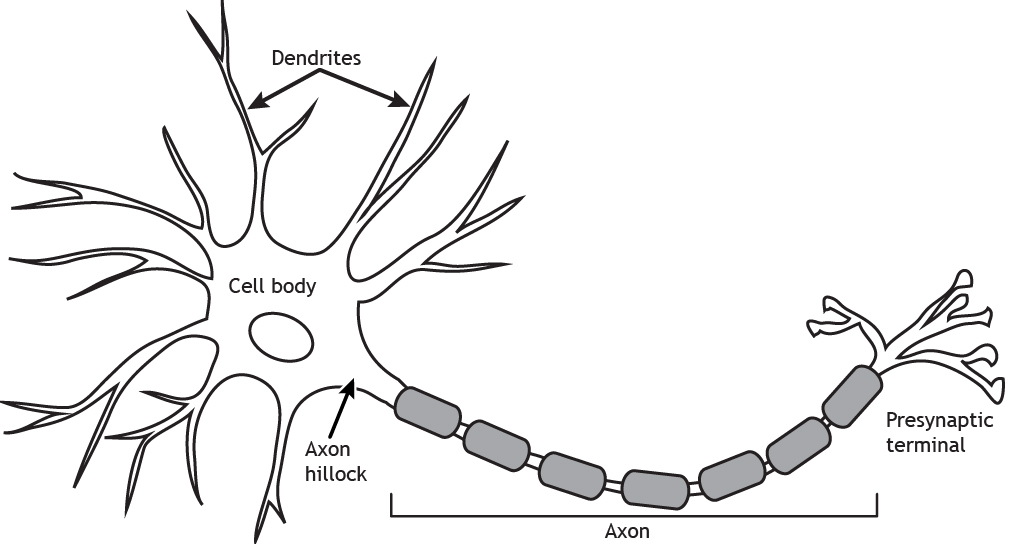
Figure 1.1. A typical neuron. Dendrites branch out from the cell body, where the nucleus is located. The axon hillock is located where the cell body transitions into the axon. The axon begins at the axon hillock and ends at the presynaptic terminal, which can branch into multiple terminals. ‘Neuron’ by Casey Henley is licensed under a Creative Commons Attribution Non-Commercial Share-Alike (CC-BY-NC-SA) 4.0 International License.
Dendrites
Dendrites, shown here in green, are processes that branch out in a tree-like fashion from the cell body. They are the main target for incoming signals received from other cells. The number of inputs a neuron receives depends on the complexity of the dendritic branching. Dendrites may also have small protrusions along the branches known as spines. Spines, illustrated in the inset box, are the sites of some synaptic contacts. Spines increase the surface area of the dendritic arbor, which may be an important factor in receiving communication.

Cell Body
The cell body, shown here in green and also known as the soma, contains the nucleus and cellular organelles, including endoplasmic reticulum, Golgi apparatus, mitochondria, ribosomes, and secretory vesicles. The nucleus houses the DNA of the cell, which is the template for all proteins synthesized in the cell. The organelles, illustrated in the inset box, in the soma are responsible for cellular mechanisms like protein synthesis, packaging of molecules, and cellular respiration.