3 Crime, Arrests and Detention: A Quantitative Baseline
A. Karnataka – An Overview Of Crime And Arrests
3.4
With a population of 6.11 crores,6 Karnataka is the 8th most populous State in India and the 7th largest by land area. As of January 2016, the investigative leg of its criminal justice system comprises 114.15 police personnel per lakh population against a sanctioned strength of 177.36, which is substantially lesser than the national average of 180.597. The criminal court system includes district trial courts (Judicial Magistrates and Civil Judges), Sessions Courts and the High Court. Judicial Magistrates have jurisdiction over criminal offences which are punishable with imprisonment of up to five years. Sessions Judges who preside in the Sessions Courts, have the power to try criminal offences punishable with imprisonment above five years up to the death penalty.8
3.5
Karnataka has 8 central jails and 19 district jails, with a capacity of 13,759 persons. However, prisons in Karnataka are running over their full capacity and as of 2016, 107.9% of the total capacity of prisons in the State was occupied.9
3.6
As per the NCRB data, in 2016, around 71% of the prison population in Karnataka were under-trial prisoners. The NCRB adopts the census method to account for the prison population. Hence, while we know the number of prisoners at the end of the year, we have no estimate of the prisoners who were detained in the prison at some point during the year.
3.7
Further in the Prison Statistics, 2016, the NCRB has excluded any analysis of prisoners on the basis of their caste and religion, unlike the prison statistics of the previous years, and without offering any explanation for this change.10 Therefore, in order to ensure to ensure consistency in comparison across different themes, we study and analyse data on prison statistics in Karnataka between 2010-2015.
3.8
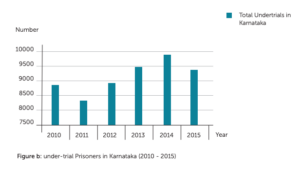
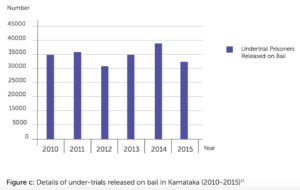
In Figures b and c, we compare the number of under-trial prisoners in Karnataka at the end of the year with the number released on bail in each year.
3.9
While the total number of under-trial prisoners released on bail in 2015 is marginally lower than in the previous years, 2014 boasts of the highest numbers of detenues released in the last 6 years. Hence, no clear trend is discernible. Significantly, the under trial population in Karnataka has steadily increased between 2012 and 2014 but drops in 2015. So, there appears to be no direct relationship between the overall under trial population and the number of detenues released on bail.
3.10
More significantly, we must explain why the number of prisoners released on bail is nearly four times that of the under trial population. As the NCRB report adopts a census method, the number of under trial prisoners recorded by the reports only provides a sense of the ‘stock’ of detenues in the prison system at a given point in time and not the ‘flow’ i.e. the number of persons who are arrested and subsequently released in the year.
3.11
Though we have no available data on the overall flow of under trial detenues in any year, from the NCRB Prison Statistics 2015, we can analyse (I) the demographic profile of detainees in Karnataka, (II) the offences for which they have been detained and (III) variations in reporting of crime across the State, if any.
I. DEMOGRAPHIC PROFILE OF UNDER-TRIAL PRISONERS
3.12
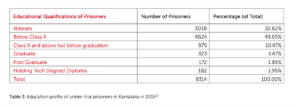
In Karnataka, nearly 80% of undertrial prisoners at the end of 2015 had never secured a high school education. Further, more than 30% were illiterate, which is to be seen in light of Karnataka’s reasonably high literacy rate of 75.36%.12 Hence, it appears that educationally disadvantaged persons are particularly vulnerable to incarceration. We were unable to determine whether this demographic bias against educationally backward persons takes place at the stage of arrest, during bail decision-making or in the system of probation and parole, as we do not have similar demographic data on those arrested.
3.13
A substantial 82% of under trial prisoners in Karnataka are Hindu. With religious minorities such as Muslims and Christians, the number of under trial prisoners coincided with the proportion of Muslim and Christian population in Karnataka.
3.14
SCs and STs constituted about 18% of the under trial population in Karnataka, while the general category constituted almost 80% of the under trial population. As census data on the OBC population and general category was unavailable, we were unable to compare the proportion of under trials in each caste category with the caste category as a proportion of the total population of Karnataka.