4 Arrest and Bail: The Legal Framework
4.1
In India, any person may be arrested by an investigating authority on a reasonable suspicion that an offence has been committed. Such a detenue may secure a conditional release – bail – from the relevant authority. If the offence is categorised as a ‘bailable’ offence, the detainee may secure bail at the police station. However, if the offence is categorised as a non-bailable offence, the detenue must seek bail from the appropriate court.
4.2
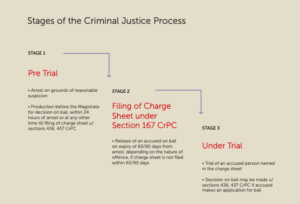
In this background, we outline the law applicable to arrest and grant of bail. We introduce the distinction between the ‘pre-trial’ and ‘under-trial’ stages of the criminal process – one that has not been made 04 Arrest and Bail: The Legal Framework in the substantive law, academic analysis or policy literature in India. We argue that this distinction is essential in identifying relevant factors to be considered while making a bail decision and the appropriate weights to be attached to them at different stages of the criminal justice process. Next, we present an outline of the law applicable at the pre-trial and under-trial stages of the criminal justice process and briefly review the theoretical considerations that shape this area of law as well as the recent efforts of the Supreme Court at reform. The Chapter concludes with a review of the latest attempts to reduce under-trial detention rates in India and highlights how existing law has failed to substantively regulate bail decision making in courts.
A. Legal Framework of Arrest and Bail
4.3 Under Section 41, the investigating authorities may arrest a person on a reasonable suspicion that an offence has been committed, whether bailable or non-bailable. The provisions applicable to a bail decision differ based on whether an offence is classified as bailable or non-bailable in Schedule – I of the CrPC.
While the power of courts and police to grant bail in case of a non-bailable offence is discretionary,6 a person arrested for a bailable offence has a right to be released on bail by the police. This may take place within 24 hours from the time of arrest. Where an arrested person has been refused police bail for a bailable offence, they may approach the court to secure bail.7 4.4 Every arrested person must be produced in court within a period of 24 hours of arrest, which is commonly known as ‘first production’.8 At first production, the court decides whether to release the arrested person on bail or remand them to judicial or police custody.
Although the judiciary has been largely silent1 on the arbitrariness of the classification of bailable and nonbailable offences, several legal reform efforts have attempted to confront the issue:
- The Expert Committee on Legal Aid (1973) headed by Justice Krishna Iyer recommended enlarging the category of bailable offences in the CrPC to facilitate grant of bail in a greater number of offences and to ensure expeditious completion of pre-trial procedures.
- In its 154th Report (1996), the Law Commission of India reviewed the law on arrest and supported the finding of the National Police Commission that a substantial number of arrests were made in cases of minor offences and were not necessary for crime control.2
- The Malimath Committee on Reforms of the Criminal Justice System (2003) recommended a complete overhaul of the criminal justice system, including reclassifying offences into separate codes.3 Significantly, the Committee referred to specific factors such as nature of the crime, degree of violence, injury to victim/property, societal impact, and the possibility of using alternative dispute resolution methods to determine whether an offence ought to be classified as bailable or nonbailable and cognizable or non-cognizable.4
- Recently in its 268th Report, the Law Commission of India (2017) also emphasized the need to rationalize the classification of offences and recommended that the seriousness of the offence must reflect in its classification as bailable or nonbailable.5
While the power of courts and police to grant bail in case of a non-bailable offence is discretionary,6 a person arrested for a bailable offence has a right to be released on bail by the police. This may take place within 24 hours from the time of arrest. Where an arrested person has been refused police bail for a bailable offence, they may approach the court to secure bail.7